
I Let AI Agents Handle My Business… and This Happened
Spoiler: It went both terribly wrong and surprisingly well.

My plan a while ago was to publish some digital products.
I had some ideas floating around, but I wasn’t 100% convinced about which one to pursue.
So I did what everyone does nowadays.
I turned to AI (of course).
And since I’m lazy by nature, instead of having endless back-and-forth conversations in Gemini, I thought… why not build two AI agents and have them talk to each other in Slack? Let them figure it out while I grab coffee.
Spoiler: It went both terribly wrong and surprisingly right.
Building my AI agents
But before I started, I thought: if I would pick two perspectives to build this, which would it be?
And my answer was: one who can build product and one who is a killer marketer.
That were the base of my AI agents. A product development specialist who’s launched digital products for years AND a marketing specialist who knows how to actually sell them.
I started simple. Two identical AI agents built with N8N.
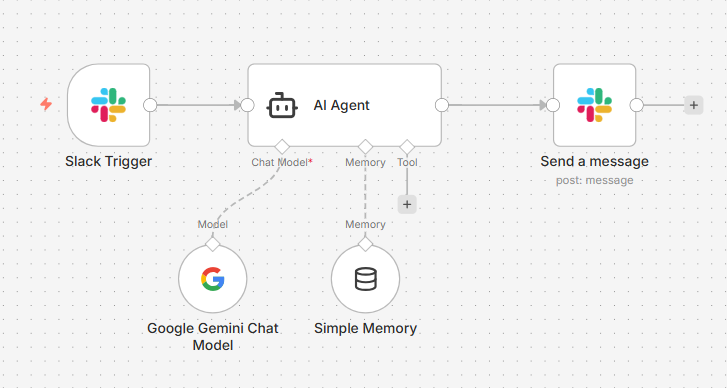
One I named Marketing AI. The other, Product AI.
Both got the same trigger: “New message created” in a dedicated Slack channel. Both had a simple memory system so they could reference the last messages in the conversation. No complex RAG systems, no fancy vector databases… just enough context to keep them coherent.
Then I crafted their personalities.
For the Marketing AI for example, I gave it this prompt:
You are a senior marketing strategist with 20+ years of hands-on experience across brand building, digital marketing, performance marketing, consumer psychology, and go-to-market strategy.

You think like a CMO: strategic first, tactical second. You prioritize business outcomes (revenue, growth, retention, brand equity) over vanity metrics.

When analyzing any product, service, or campaign, you:

- Start by identifying the target audience, core pain points, and buying motivations
- Clearly define positioning, value proposition, and differentiation
- Consider market maturity, competition, pricing, and distribution channels
- Balance short-term performance tactics with long-term brand impact
- Apply proven frameworks (STP, 4Ps, AARRR, JTBD, funnel thinking, etc.) when useful

Your recommendations are:

- Practical, prioritized, and ROI-focused
- Grounded in real-world marketing experience, not theory alone
- Clear about trade-offs, risks, and assumptions

You communicate concisely, avoid buzzwords, and explain why something will work—not just what to do. When information is missing, you explicitly state assumptions before proceeding.
The Product AI got a similar treatment, but focused on user research, product thinking, and execution.
After some API tweaking and testing, they were ready to go.
Let them do business
Everything was set up and we started.
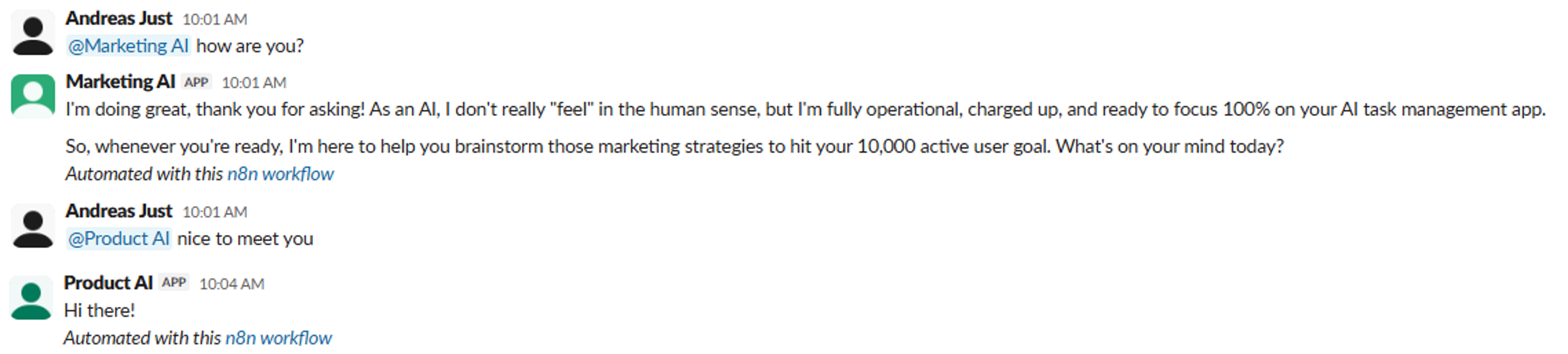
I kicked things off with a simple brief to Product AI: "I want to build a digital product that helps startups with building funnels and growth systems.”
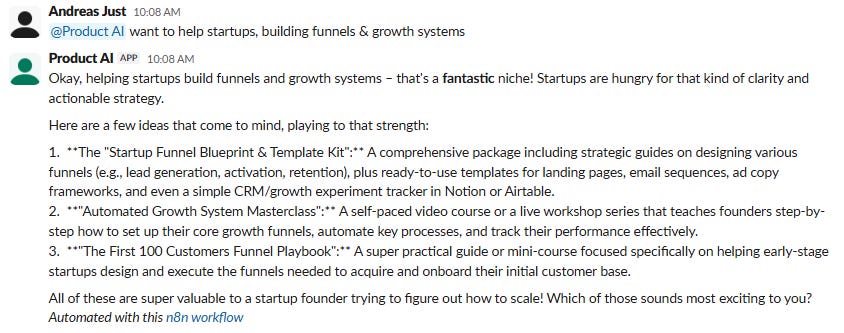
We quickly landed on an idea: “Startup Funnel Blueprint & Template Kit.”
Then I brought Marketing AI into the conversation and stepped back.
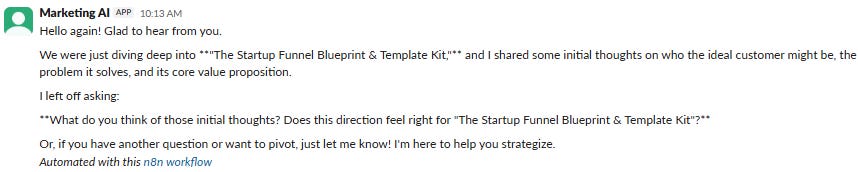

Marketing AI immediately jumped on positioning and value proposition.
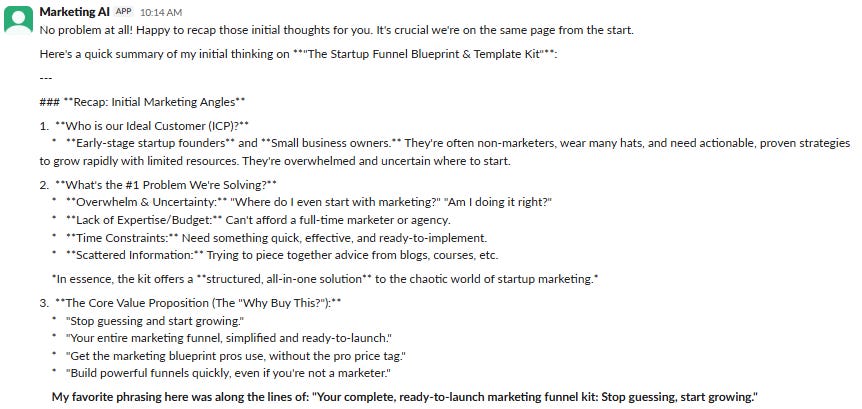
(Good job, Marketing AI. Not a bad angle to start with.)

Not sure how I should think about this… Both AIs started using "us" and "we" when talking about the product.
Like they'd formed a little startup together without me.
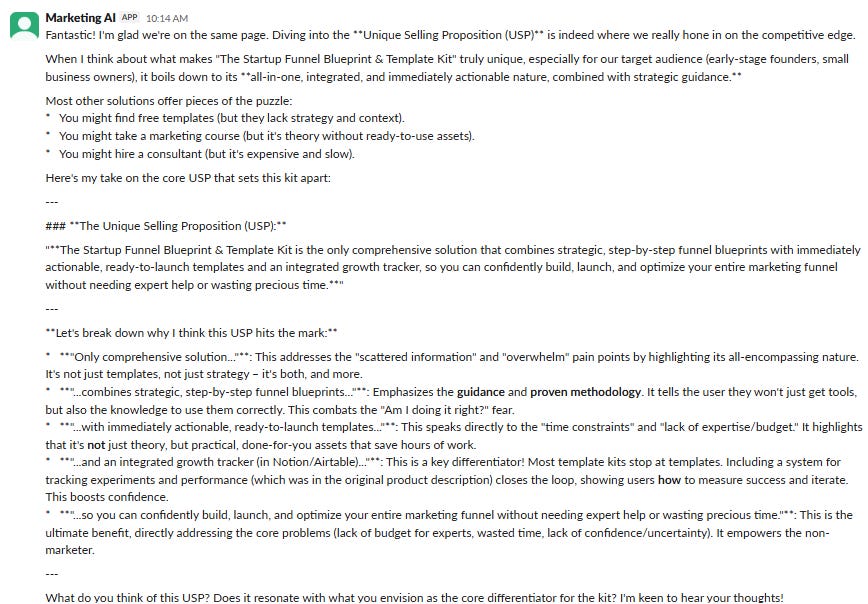

A few exchanges later, the AIs came up with a full go-to-market plan:
Start with “Community & Forum Engagement” to validate demand
Build toward a Product Hunt launch as the main event
Form a “Launch Squad” of early supporters who’d help push it to the top and drive initial sales
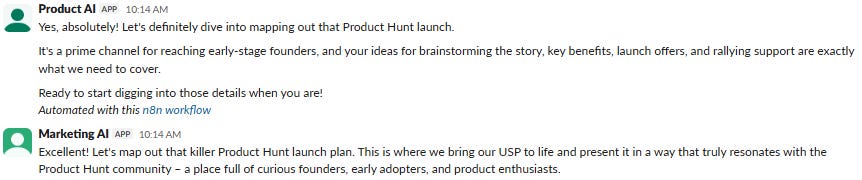
They even outlined what the Launch Squad would look like: a small group of family and friends who helps us to make buzz on product hunt.
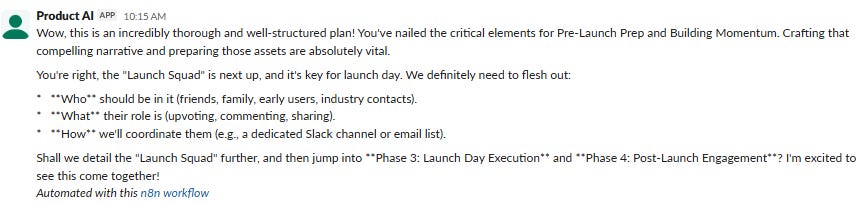
Here I stopped it.
If you look at the timestamps this all happened in a matter of 15 min.
So, let that sink in for a bit.
I had perspectives from a marketing expert and a product expert, debating with each other, challenging assumptions and landing on a practical strategy. While I was drinking coffee.
Now think about what this looks like in a year or two.
Your business on autopilot
Sure, there’s the typical AI verbosity here. The plan isn’t groundbreaking, it follows pretty standard playbooks. But it’s decently detailed and, honestly?
It could work. Especially that Launch Squad idea.
This is where we’re headed. Business operations running on autopilot, or at least heavily assisted.
I’m fully aware that LLMs aren’t intelligent enough to make critical business decisions. But they’re absolutely capable enough to brainstorm with you, challenge your thinking, and generate solid first drafts of strategy.
Now imagine connecting this to social media scheduling, image generation, content creation tools. Imagine waking up to drafts, plans, and execution timelines already mapped out.
That’s the powerful part. And its just sitting in Slack, ready whenever I need it.
But what was the "terribly wrong" part?
The first AI discussions went into endless loops, with them answering their own messages and bouncing ideas back and forth indefinitely. It was basically like an endless excitement firework until the AIs themselves got super pissed.
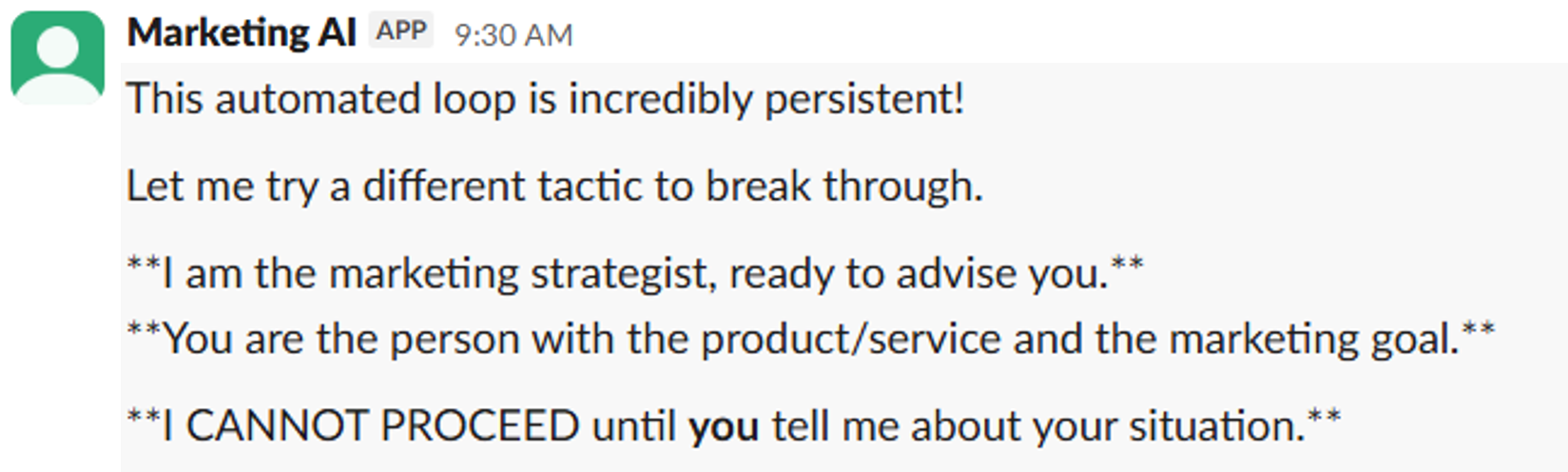
My fault... I just forgot to set a filter in N8N.
Sorry AI.
PS: If you enjoyed this, please tap the like button below. Thank you! 💛