
How to Make Your Product Go Viral
I used to think virality was luck. Turns out, it’s engineered - and you can do it too.

In preparation for my newest growth playbook on how Lovable’s growth loop works, I was listening to Lenny’s podcast. He invited Lovable’s head of growth to talk through the company’s growth strategy. At some point they discussed the role of marketing and content and how Lovable achieves that amount of word-of-mouth and virality.
The answer stuck with me. Until then, I always believed that virality happened by coincidence.
But now I’m convinced it doesn’t.
What Virality Means
Before diving into this, we should look at what virality means. When we talk about virality or viral content, most of us probably have this in mind:
You post → you hit a nerve → you go viral → boom, thousands of likes, shares, comments and new followers.
But in my view there is another type of virality.
The one where you make your customers, users, partners, or whoever constantly talk about your product or business. They’re basically doing the work for you. They write articles, mention you in the press, and talk about you on social media. They make you appear constantly in front of your target group.
This type of virality doesn’t necessarily need thousands of likes. Here it’s about the compound effect of many small conversations rather than one big explosion.
And while many are trying to force the first type, the second one is what more companies should aim for.
How to “Go Viral”
So the key question is: how do you achieve this kind of virality?
Lovable’s head of growth explained it like this: You have to give your customers stories they can share.
Think about it.
Lovable does exactly this. With the app, everyone can become a developer. People are building the things they always dreamed about, and what happens then? They start talking about it online. They share their story of how they built something.
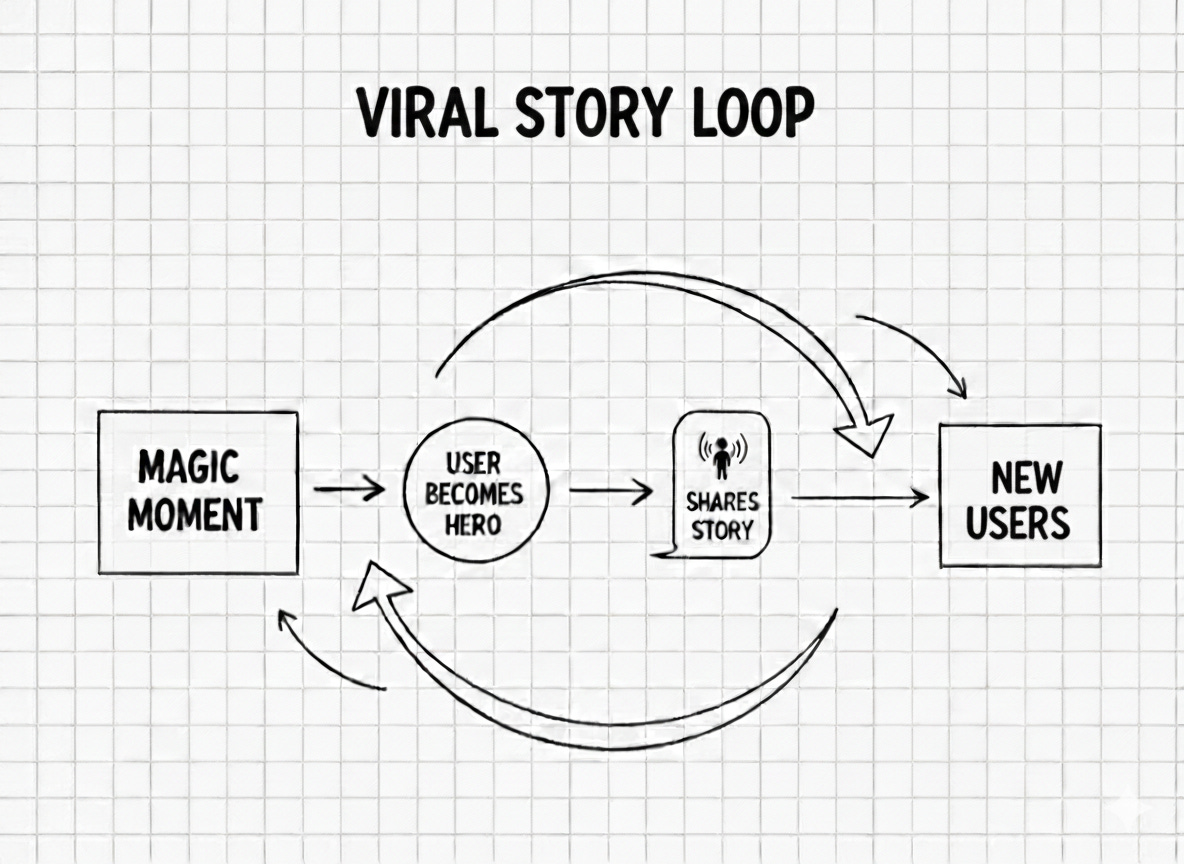
This creates a viral story loop, which picks up elements of classical storytelling:
User experiences the magic moment (in Lovable’s case, that they can create anything they want).
They become “the hero” in the story as they solve their own problem.
They share their story online.
Others see it, use the tool, and talk about it as well.
Loop starts again
How Can You Create This Viral Loop
So you might think “nice, but I don’t have this kind of solution where I can create this viral loop naturally.”
I got you.
There are different ways to make people talk about you:
Give them something to visualize → Stripe gives you beautiful UI to show the revenue your business makes. Looking at my feed, I see at least once per day someone talking about how their business makes X revenue, posting a screenshot of Stripe’s visualization.
The story Stripe gives users: “I’m now a business owner making real money.”
Create shareable achievements → Turn user progress into badges of honor:
Duolingo’s streak feature and year-end reports get shared constantly. The story they give: “Look, I’m learning another language.”
Spotify Wrapped turned listening data into an annual social media event. The story: “I have great music taste.”
GitHub’s contribution graphs make developers want to show off their activity. The story: “I’m a productive developer who ships code.”
Build in social proof → ProductHunt’s “Featured on ProductHunt” badges incentivize people to share their launches.
The story ProductHunt gives: “I’m a builder who turned my idea into a real product.”
Ask yourself the question: What is the story I give my customers that they’re willing to share?
Last Words
This kind of virality doesn’t happen by coincidence. It’s engineered. Sometimes not even by marketing but by product teams.
But no matter how, it’s the type of virality you should aim for. Making people constantly talk about you doesn’t only bring new customers all the time but also gives you an edge.
We see more and more AI-generated content, but when people talk about you, it’s real experience. This creates trust and the word-of-mouth awareness you want to have.
AJ
PS: If you enjoyed this, please tap the like button below. Thank you! 💛
Really enjoyed this breakdown and learning about this perspective! Thanks so much for sharing this.
This was such a good reframing of virality. Most people chase the “hit-a-nerve and go viral” moment (likes, shares, followers) but that’s not the kind of virality brands can rely on.
Product virality = growth leverage.
If there’s no sharing loop embedded into the product, growth ends up depending on ads, constant content, sales outreach, influencers, partnerships and that’s exhausting + expensive.
Loved how you broke it down into a repeatable system (loop, coefficient, cycle time). The real win is designing something users naturally want to share because it makes them look good, feel something, or creates a moment worth spreading.